The short answer: a turbo trainer is a stand that holds your own bike still so you can ride it indoors. There are three main types. A wheel-on trainer clamps the rear axle and presses a roller against your back tyre: it fits most bikes and is the simplest to set up, but it is the noisiest and wears the tyre. A direct-drive trainer replaces your rear wheel: the chain runs on a cassette fitted to the trainer, so it is quieter and more stable, but you have to check that your frame and gears are compatible. A smart trainer (wheel-on or direct-drive) adds electronics so an app can control the resistance and read your power. Rollers are a fourth option, with no clamp at all. If you commute on a bike with hub gears, a wheel-on trainer is usually the practical choice.
This guide is for people who ride to work and want to keep their legs going on the dark, wet weeks when the commute is cancelled, or who want a way to build fitness before they start commuting. It explains how each type works, how to check your bike will fit, and what the jargon on the box means. It does not rank individual models; specifications change, so check the manufacturer’s page and the current price before you buy.
Turbo trainer types at a glance
| Wheel-on | Direct-drive | Rollers | |
|---|---|---|---|
| How the bike is held | Rear axle clamped, tyre on a roller | Rear wheel removed, frame bolted to the trainer | Not held: you balance on the drums |
| Set-up | Quick, wheel stays in | Rear wheel off each time | None, but riding takes practice |
| Noise | Loudest: tyre on roller | Quieter: mostly drivetrain noise | Varies by model |
| Tyre wear | Yes, a trainer tyre is advisable | None | Check the maker’s tyre advice |
| Hub-gear bikes | Usually possible with the right axle nuts | Usually not, as there is no cassette to move | Possible |
| Main catch | Noise and tyre wear | Frame, axle and cassette compatibility | Balance; not ideal in a small space |
Wheel-on trainers
A wheel-on trainer is a folding A-frame. Your rear axle is clamped between two cups, and a small roller presses against the rear tyre. Resistance comes from a magnetic unit, a fluid unit or, on smart models, an electronically controlled brake behind the roller.
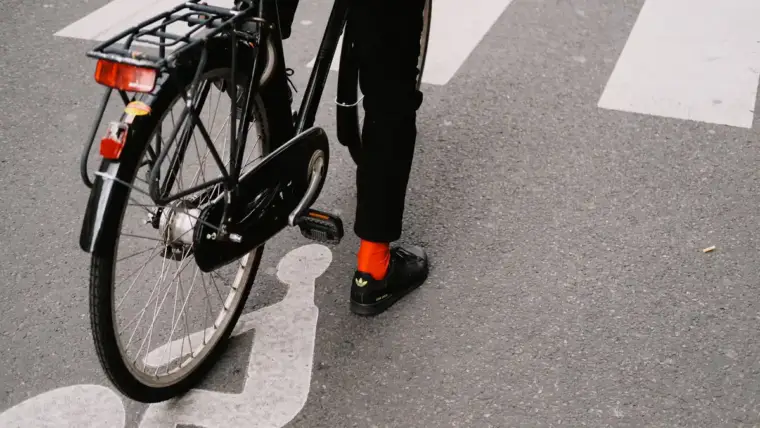
Why they suit commuter bikes: you don’t take the wheel off, and you don’t need to match a cassette. That matters if your commuter has hub gears, a dynamo hub or an unusual axle.
What to check before you buy:
- The rear axle. Most wheel-on trainers clamp a quick-release skewer, and many come with their own trainer skewer, which has ends shaped to sit in the clamp. If your bike has a thru-axle (a thick bolt-through axle, common on bikes with disc brakes), you will need a trainer-specific thru-axle adapter. Elite and Tacx both sell them. As Zwift Insider’s guide to Tacx adapters explains, you need to match the axle’s length, diameter and thread to your frame, so measure or check your bike’s specification first.
- Hub gears. Bikes with a Shimano Nexus or Alfine hub have a solid axle held by nuts, not a quick release. Tacx sells axle nuts for Nexus and Alfine hubs designed for its wheel-on trainers, and states they are not compatible with its direct-drive trainers. Check the equivalent part for the trainer you are considering.
- The tyre. A normal road or commuting tyre wears quickly on the roller and can get noisy. Tredz’s set-up guide recommends a harder-compound or trainer-specific tyre on the rear wheel. Many riders keep a spare rear wheel with a trainer tyre fitted, so the commuting tyre stays fresh for the road. Our guide to commuting tyres covers what to fit for the road.
- Roller pressure. Too little and the tyre slips; too much and it wears faster. Follow the trainer’s instructions, and pump the tyre to the same pressure each session so the resistance feels consistent.
Direct-drive trainers
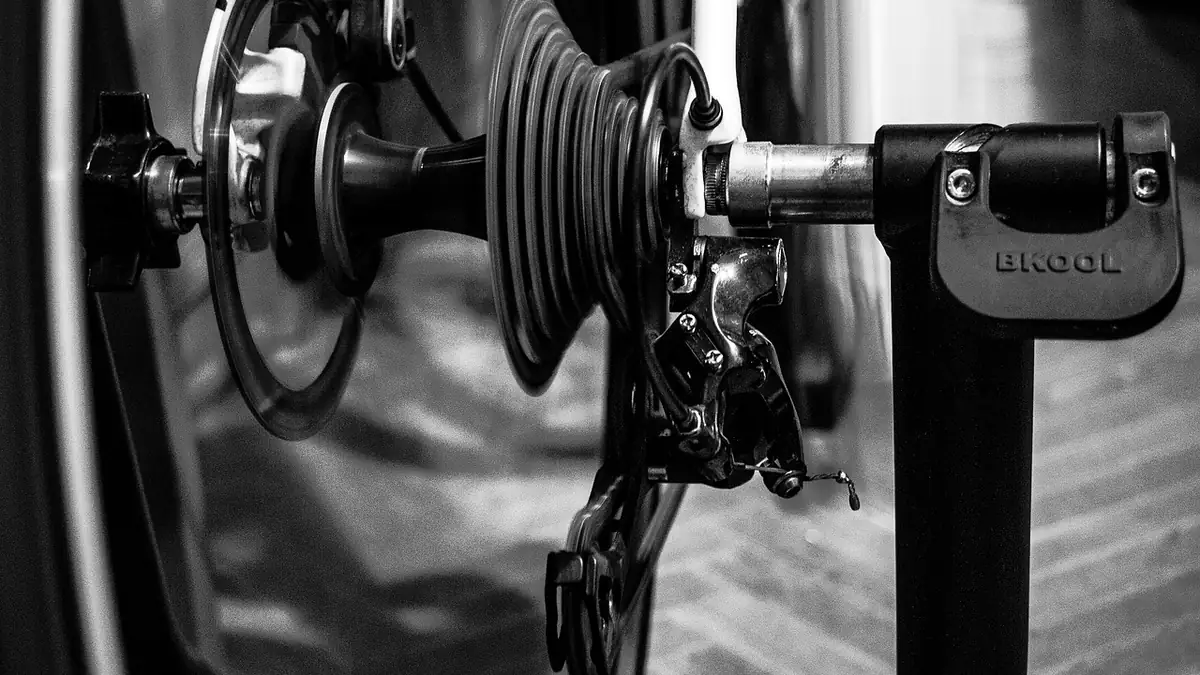
With a direct-drive trainer you take the rear wheel off and fit the frame’s dropouts straight onto the trainer’s own axle. The chain drives a cassette mounted on the trainer, which spins a heavy flywheel and the resistance unit.
Because there is no tyre on a roller, the main source of noise disappears. road.cc’s explainer on trainer noise makes the point that tyre-on-roller contact is louder than the drivetrain, and the drivetrain is almost the only noise a direct-drive trainer makes. If you live in a flat, though, vibration through the floor can annoy the neighbours more than the sound itself; a dense trainer mat helps.
Compatibility is the whole game. Check three things against the manufacturer’s compatibility page:
- Axle standard. Rear hubs are either quick-release, usually 130 mm (road) or 135 mm (most hybrids, commuters and mountain bikes) wide, or thru-axle, commonly 12 mm in diameter and 142 mm or 148 mm wide. As an example, Wahoo’s support pages list the KICKR CORE’s adapters as covering 130 and 135 mm quick release and 12×142 and 12×148 mm thru-axles, and say it does not support bolt-on hubs. Wahoo also says the rider is responsible for checking that their frame is compatible, and that some frames need updated adapters sold separately. Other brands publish similar lists.
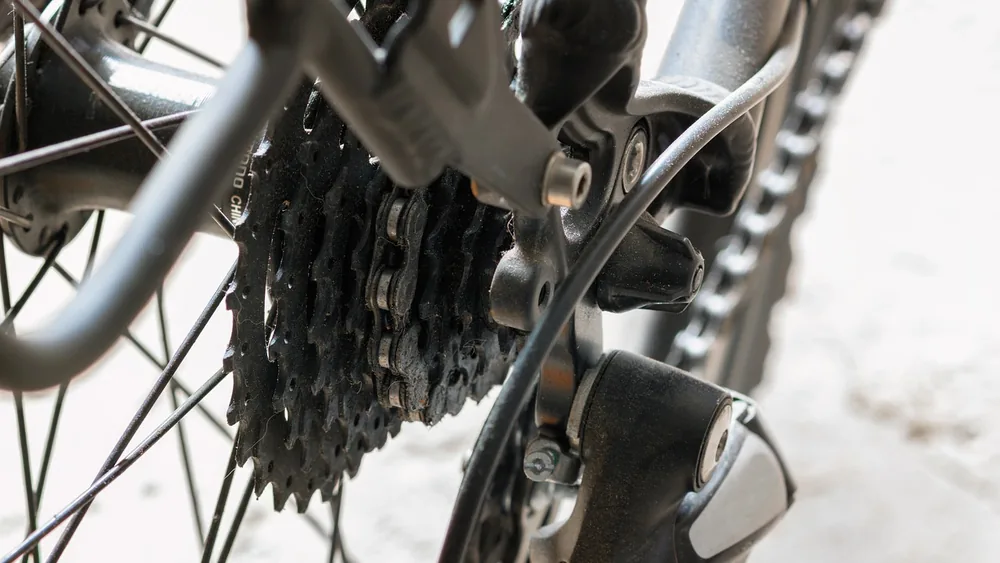
- Cassette. Some direct-drive trainers come with a cassette fitted and some don’t. The cassette needs to match your bike’s number of gears (for example 8, 9, 10, 11 or 12 speed) and the trainer’s freehub body. If it is not included, budget for one and the tool to fit it.
- Your gears. A bike with an internal hub gear has no cassette to move to the trainer, so a standard direct-drive unit is normally not an option. Some trainers now use a single fixed cog with “virtual shifting” controlled by an app or handlebar buttons instead of a cassette; Zwift’s compatibility page for its Cog system lists Shimano Alfine and Nexus hub gears as not compatible, so the same caution applies there.
If you are still choosing a commuter bike, our hybrid vs road bike comparison explains the frame differences that also affect trainer fit.
What makes a trainer “smart”
A smart trainer has a resistance unit that can be controlled electronically and a sensor that measures your power output. It talks to an app on a phone, tablet, computer or bike computer, usually over Bluetooth and ANT+. Training and riding apps such as Zwift, Rouvy and TrainerRoad use that link in two ways:
- Simulation mode: the trainer makes it harder when the virtual road goes uphill and easier on the descents.
- ERG mode: you are given a target power and the trainer adjusts to hold it. Wahoo’s support pages describe how, in ERG mode, resistance increases if your cadence or speed drops, so there is no coasting.
Before buying, check that the app you want to use lists your trainer, or the connection standard it uses, as supported. App subscriptions are separate from the trainer and change over time, so check the current terms on the app’s own website.
A “dumb” (non-smart) trainer can still be useful. You change the effort with your gears, and you can add a cadence or speed sensor if you want to ride an app without automatic resistance control.
Rollers
Rollers are three drums in a frame. The bike sits on top, unclamped, and you balance as you would on the road. They train smooth pedalling and balance, they fit almost any bike, and there is nothing to bolt on. The catch is that the first few sessions take concentration: start next to a wall or a door frame you can hold on to. They are less suited to hard, out-of-the-saddle efforts than a clamped trainer.
Can you put an e-bike on a turbo trainer?
Sometimes, but check first. Owners on e-bike forums report mixed results: with a direct-drive trainer, removing the rear wheel can also remove the wheel-speed magnet the motor system reads, and rear hub-motor bikes often need special axle hardware or won’t fit at all. Riding with the motor off also means pushing a heavier bike. If you want to use an e-bike indoors, ask both the e-bike maker and the trainer maker about compatibility and whether it affects the warranty.
Can you get a turbo trainer on the Cycle to Work scheme?
Usually not. Cyclescheme’s help pages list turbo trainers and rollers among the items you can’t get on the scheme, alongside items such as GPS devices, power meters and car bike racks. The scheme is built around bikes and cyclists’ safety equipment. If you use a different provider, check its current list before you order. Our guide to what the Cycle to Work scheme covers explains what is normally included, and the Cycle to Work savings calculator shows what you could save on the bike itself.
Setting up at home
- Space: you need roughly the length of your bike plus room to get on and off. A spare room or garage is ideal; check our guide to storing a bike at home if space is tight.
- A fan: indoors there is no wind to cool you. Most riders find a fan matters more than any accessory.
- Sweat: a towel over the bars and a mat underneath protect the frame, headset and floor. Sweat is corrosive, so wipe the bike down afterwards.
- Front wheel riser: with a wheel-on or direct-drive trainer the back of the bike is lifted, so a riser block keeps the bike level.
- Chain care: indoor miles still wear the drivetrain. Our chain cleaning and lubing guide applies as much to indoor riding as to the commute.
Which type should a commuter choose?
- You ride a hub-gear or dynamo-hub commuter, or don’t want to take wheels off: a wheel-on trainer, with a trainer tyre on a spare wheel if you can.
- You have a derailleur bike, live in a flat and care about noise: a direct-drive trainer, after checking the axle and cassette compatibility on the manufacturer’s site.
- You want structured workouts or virtual rides: a smart trainer, wheel-on or direct-drive, and check app support before you buy.
- You want to improve balance and pedalling and have room to wobble: rollers.
Indoor sessions are a stopgap, not a replacement for riding outside. When the weather turns, our guides to cycling through a British winter and cycling in the rain may get you back on the road sooner than you think. If you’re curious about the energy side, the cycling calorie calculator gives an estimate based on your weight, how long you ride and how hard.
Frequently asked questions
What is the difference between a turbo trainer and a smart trainer?
“Turbo trainer” is the British name for any stand that holds your bike for indoor riding. A smart trainer is a turbo trainer whose resistance can be controlled by an app and which measures your power. Both wheel-on and direct-drive trainers come in smart and non-smart versions.
Will a turbo trainer fit a thru-axle bike?
Usually, with the right adapter. Direct-drive trainers typically include or sell adapters for the common 12×142 and 12×148 mm thru-axles. Wheel-on trainers need a trainer-specific thru-axle that matches your frame’s axle length, diameter and thread. Check the trainer maker’s compatibility list for your frame.
Can I use a turbo trainer with a hub-gear bike?
Generally with a wheel-on trainer, using axle nuts made for the trainer. Standard direct-drive trainers need a cassette, which a hub-gear bike doesn’t have, and Zwift lists Shimano Alfine and Nexus hubs as not compatible with its single-cog Cog system.
Does a turbo trainer damage your bike?
Used as the manufacturer intends, a trainer is designed to hold a bike safely. The main risks are tyre wear on wheel-on trainers, sweat corrosion and wear to the chain and cassette. If you ride a carbon frame, check the bike maker’s guidance on trainer use.
Is a turbo trainer covered by the Cycle to Work scheme?
Not with Cyclescheme, which lists turbo trainers and rollers as excluded items. Check with your own provider if you use another scheme.
This guide is general information based on the manufacturers’ published compatibility pages, Cyclescheme’s help pages and the sources linked above. Product ranges, specifications and app terms change, so check the current details and the current price before you buy.