The short answer: for most commuters, flat pedals are the better choice. You can ride in your normal shoes, put a foot down without thinking at every junction, and walk straight into the office. Clipless pedals make sense if your commute is long, has few stops, and you are happy to carry or store a second pair of shoes. If you want them, choose a two-bolt SPD-type system rather than a road system, and check how you will stay legal after dark, because many clipless pedals cannot take the amber reflectors the law asks for.
This guide covers how the two types differ, what the research says about efficiency, the reflector problem, and how to make the switch without a slow-motion topple at the lights. We have not run our own pedal tests and there are no affiliate links on this page. Prices move around, so check the current price with the retailer.
What “clipless” actually means
The name confuses almost everyone. Clipless pedals are the ones you do clip into. The word refers to the absence of old-style toe clips and straps. A metal or plastic cleat bolted to the sole of a cycling shoe locks into a mechanism on the pedal, and you release it by twisting your heel.
Flat pedals are simply a platform. Your foot rests on top and nothing holds it there except grip and gravity. The cheap plastic pair that came with your bike is a flat pedal, and so is a wide metal platform with small pins that bite into the sole of your shoe.
Flat vs clipless at a glance
| What matters on a commute | Flat pedals | Clipless (SPD-type) |
|---|---|---|
| Shoes | Almost anything you already own | Cycling shoes with two-bolt cleat mounts |
| Stopping at junctions | Just put a foot down | Twist out first, every time |
| Walking at the other end | Normal | Fine in recessed-cleat shoes, but you may want to change at work |
| Foot position | Can shift on bumps or in the wet | Held in place |
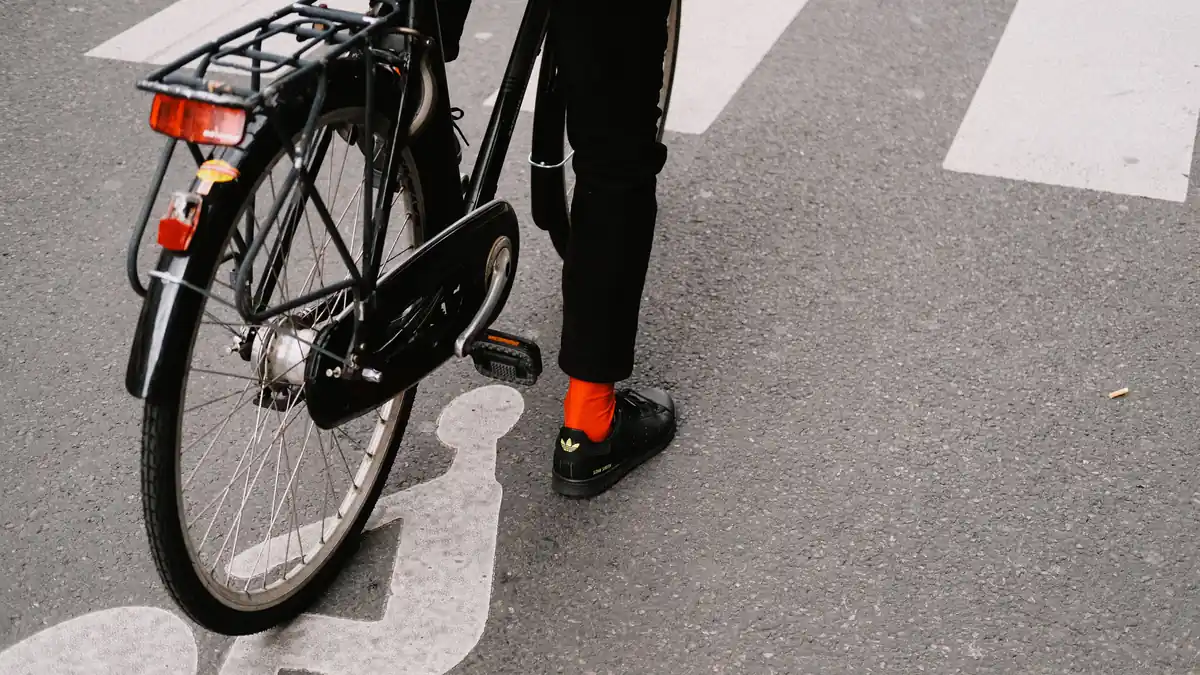
| Amber pedal reflectors | Often simple to fit | Often not possible, so check the model |
| Learning curve | None | Needs practice away from traffic |
The case for flat pedals
The biggest advantage is that they remove a decision. A commute is full of small interruptions: traffic lights, pedestrian crossings, a van pulling out, a queue at an advanced stop line. On flats, your foot comes off the pedal by reflex. That matters most where you have least room to wobble. Our guide to cycling safely in traffic has more on handling junctions.
Flats also mean one pair of shoes. If you ride in what you wear at work, or keep things simple with the approach in our guide to what to wear cycling to work, there is nothing else to pack, store or dry out. They also suit the rider who locks up and goes straight into a shop on the way home, or who switches between a bike and a train.
If your feet slide about, the answer is usually a better flat pedal rather than a different system. A wider platform with pins, paired with a flat, grippy sole, holds much better than a smooth plastic pedal under a hard or heavily curved shoe. Bear in mind that pins can mark smart shoes and will happily take a chunk out of your shin if your foot slips.
The case for clipless pedals
The honest benefit is security. Your foot stays in the right place over the axle, it cannot bounce off on a rough road surface or slide off in the wet, and you never have to look down and reposition it after setting off. Some riders with longer commutes like that consistency, particularly on stretches with few stops.
The usual claim is that clipless pedals are more efficient. For commuting speeds, the research does not back that up, as the next section explains. Choose them because you prefer the feel and the security, not because you expect the ride to take less effort.
Are clipless pedals more efficient? What the research says
Probably not at commuting effort. In a 2016 study in Footwear Science, Straw and Kram measured the metabolic cost of pedalling in eleven healthy subjects at 50, 100 and 150 watts. They compared running shoes on flat pedals, running shoes with toe clips, and cycling shoes on clipless pedals, and found no significant difference between them at any of the three power levels. The authors concluded that cycling shoes may offer comfort or safety benefits but do not improve efficiency.
Sprinting is a different story. A 2020 follow-up by Burns and Kram looked at short uphill sprints. In running shoes, adding toe clips raised maximum sprint power by about 9.7% compared with flat pedals. Stiff-soled cycling shoes on clip-in pedals then added about 16.6% over the toe-clip set-up, and the authors put that down largely to the stiffer sole.
The 2016 study is small, with eleven subjects, and its authors disclosed industry links, so treat it as a guide and not the last word. Still, the pattern is useful: being attached to the pedal seems to matter when you are pushing as hard as you can, and much less when you are riding steadily. Most commuting falls into the second category.
SPD or road cleats? Only one suits commuting
If you do go clipless, the system matters more than the brand. There are two broad families, and BikeRadar’s comparison of Shimano’s systems sets out the differences clearly:
- Two-bolt (Shimano SPD and compatible). A small metal cleat sits recessed in the sole, so you walk on the rubber tread rather than on the cleat. Most SPD pedals are double-sided, so you can clip in without flipping the pedal over.
- Three-bolt (Shimano SPD-SL, Look Keo and similar). A large plastic cleat stands proud of a stiff road shoe. It is awkward to walk in, and the pedal is single-sided, which makes it a poor fit for stop-start riding.
The two types are not compatible with each other, so pedals, cleats and shoes must all match. For commuting, two-bolt is the sensible choice. You can walk from the bike shed to your desk without clacking across the floor, and you can get back into the pedal quickly when the lights change.
Multi-release cleats for nervous beginners
Shimano makes two common SPD cleats. BikeRadar explains that the SH51 releases in a single direction, by twisting your heel, while the SH56 multi-release cleat also lets go when you roll your foot or pull up. That makes getting stuck less likely, and the SH56 can suit urban riding. The trade-off is that you are more likely to unclip when you do not mean to. Winding down the release tension on the pedal is another way to make things easier.
The halfway house: flat on one side, SPD on the other
Dual-sided pedals such as the Shimano PD-EH500 have an SPD mechanism on one face and a flat platform on the other, with adjustable release tension on the SPD side. Retailers including Spa Cycles list them for this kind of mixed use. You can clip in for the ride to work and use the flat side in ordinary shoes for a quick trip to the shops. The catch is that the pedal is not always the right way up when you set off, so you will sometimes have to flip it with your foot. Model availability changes, so check what is currently in stock.
The reflector problem nobody mentions
This is the point that catches out commuters riding through a British winter. Highway Code Rule 60 says a bike manufactured after 1 October 1985 must be fitted with amber pedal reflectors at night, and the Department for Transport’s pedal cycle lighting guidance specifies them front and rear on each pedal for any cycle used between sunset and sunrise. Our commuting accessories checklist covers the rest of what the law expects.
Many flat pedals take reflectors without fuss, and some come with them. Clipless pedals often have nowhere to put them. Cycling UK’s guide to the lighting rules says that because some clipless systems will not take reflectors, they technically should not be used in the dark. It adds that reflective ankle bands are a suitable substitute for visibility, but they do not meet the legal requirement.
That leaves two practical routes if you ride in the dark. One is a caged or platform-style SPD pedal that accepts reflectors: Shimano, for example, has a reflector set for its PD-M323 pedal. Check that a set exists for your exact model before you buy. The other is to stay on flats through the darker months. Ankle bands are still worth wearing, because moving reflective material catches the eye, but treat them as an addition and not a legal fix.
How to make the switch to clipless
If you have decided to try it, do the learning away from traffic.
- Fit the pedals properly. Park Tool’s guide has the details. The right pedal tightens clockwise and the left pedal has a left-hand thread, so it tightens anticlockwise. Grease the threads and start each one by hand so it does not cross-thread. Many pedals are stamped L and R.
- Start with the release tension low. Tighten it later if your foot comes out when you do not want it to.
- Practise stationary first. Lean against a wall or door frame and clip in and out with each foot until the twist feels natural.
- Move to a quiet car park or park path. Practise stopping, with the same foot coming out first each time. Unclip earlier than you think you need to.
- Keep the first real commutes simple. Pick a calm time or a quieter route, because a junction is a bad place to rehearse. You can leave one foot unclipped as you approach a stop.
The classic beginner’s mistake is stopping, forgetting to unclip and slowly tipping over. That is the reason to get your practice done somewhere quiet.
Which should you choose?
- Short urban commute with lots of stops: flats. Clipless adds a task at every junction and gives you little in return.
- New to commuting: flats. You already have enough to learn, and our guide to starting to cycle to work covers the things that matter more.
- Long commute with few stops, and shoes kept at work: two-bolt clipless is a reasonable option if you like the feel, with a plan for reflectors in winter.
- Mixed riding, or not sure yet: dual-sided flat and SPD pedals let you try clipless without giving up ordinary shoes.
- Already ride a road bike with three-bolt cleats: they will work, but think about the walking and the reflectors before using the same set-up every day.
Swapping pedals is a job you can do at home with the right tool, so you are not locked into your first choice. If you are buying through a salary sacrifice scheme, shoes and accessories may be treated differently by each provider, so read our guide to what Cycle to Work covers and check with yours first.
Frequently asked questions
Are clipless pedals worth it for commuting?
For short, stop-start urban journeys, usually not. They can suit longer commutes with fewer stops, but a 2016 study found no significant efficiency difference at steady efforts of 50 to 150 watts, so the case rests on security and personal preference.
Can you ride clipless pedals in normal shoes?
Not comfortably or securely on most double-sided SPD pedals, because the small body offers little support and the mechanism is hard underfoot. If you want the option, use a dual-sided pedal with one flat face.
Are clipless pedals legal at night in the UK?
Highway Code Rule 60 requires amber pedal reflectors at night on bikes made after 1 October 1985. Cycling UK says clipless pedals that cannot take reflectors technically should not be used in the dark, and that reflective ankle bands do not meet the legal requirement. A pedal that accepts reflectors avoids the issue.
What is the difference between SPD and SPD-SL?
SPD uses a small two-bolt cleat recessed into the sole, which makes walking easy. SPD-SL uses a larger three-bolt cleat that sticks out from a road shoe. They are not compatible, and SPD is the more practical choice for commuting.
This guide is general information based on the Highway Code, the Department for Transport’s pedal cycle lighting guidance, Cycling UK, Park Tool, BikeRadar and the two Footwear Science papers cited above. Rules and product ranges can change, so check the current position before you buy.