The short answer: there are three kinds of bike rack for a car. A towbar rack is the easiest to load and the best choice for heavy bikes and e-bikes, but your car needs a towbar. A roof rack keeps the back of the car clear but means lifting the bike above your head and remembering it is up there. A boot (strap-on) rack needs no extra fittings, but it suits fewer cars and is the type most likely to hide your number plate and lights. Whichever you choose, UK law says your registration plate must stay readable and your brake lights and indicators must stay visible. If the rack or bikes cover them, you need an extra plate and a lighting board.
This guide is written for people who cycle to work, or want to, and need a car for part of the journey: driving to a station or a park-and-ride and riding the last stretch, taking a bike to the shop for a service, or getting a new bike home. It covers the three rack types, the legal points that catch people out, and how to check weight limits before you buy.
Towbar, boot or roof: the quick comparison
| Towbar rack | Boot (strap-on) rack | Roof rack | |
|---|---|---|---|
| What your car needs | A towbar, ideally with an electrical socket | A compatible boot or tailgate | Roof bars |
| Loading | Low, at about waist height | Low to medium | Bike lifted over your head |
| Heavy bikes and e-bikes | Best suited, within the rack’s and car’s limits | Check the per-bike limit carefully | Often limited by the carrier’s bike-weight rating |
| Number plate and lights | Usually comes with its own light board and plate holder | Often covers both: you add a plate and light board | Not usually affected |
| Access to the boot | Many models tilt away from the car | Limited while fitted | Unaffected |
| Main catch | Towbar cost and nose-weight limit | Fit varies by car; straps can mark paint | Extra height under barriers and garage doors |
The UK rules: number plates, lights and loads
This is the part most rack buyers skip, and the part that can cost a fine.
Your number plate must stay readable
Under section 43 of the Vehicle Excise and Registration Act 1994, it is an offence for a registration mark to be “obscured” or allowed to become “not easily distinguishable”. The driver is liable while the car is being driven, and the maximum penalty is a level 3 fine. GOV.UK’s guidance on displaying number plates puts it plainly: “You could be fined up to £1,000” for incorrectly displayed plates.
The law does allow a defence if you took all reasonably practicable steps to stop the mark being obscured, but a bike rack you fitted yourself is hard to argue as unavoidable. The practical fix is a second plate showing your car’s registration, fixed to the rack or its light board.
You can’t simply print one. GOV.UK’s page on getting number plates made up says plates can only come from a registered number plate supplier, and the supplier must see original documents proving your name and address (a driving licence or a recent utility bill, for example) and your right to the registration, such as the V5C logbook. Take both with you.
Brake lights and indicators must stay visible
Regulation 21 of the Road Vehicles Lighting Regulations 1989 covers loads and equipment that obscure “any obligatory lamp, reflector or rear marking”. If that happens, the lamp must be moved to where it isn’t obscured, or an additional lamp fitted to the vehicle, load or equipment. For most lamps this applies between sunset and sunrise, but for stop lamps (brake lights) and direction indicators it applies in all circumstances. A rack that hides your brake lights on a sunny afternoon is still a problem.
That is what a lighting board does: it repeats your rear lights, brake lights and indicators at the back of the rack, and usually carries the extra number plate. Towbar racks generally have one built in, powered from the car’s towbar socket. For boot racks you normally buy a board separately.
Secure the load
Rule 98 of the Highway Code says you “MUST secure your load and it MUST NOT stick out dangerously”, and that you “MUST NOT overload your vehicle or trailer”. It also notes that carrying a load may mean adjusting your headlights. For a bike rack, that means every strap and clamp tight, pedals and handlebars turned so nothing sticks out sideways, and the total weight within the limits below.
Towbar bike racks
Towbar racks clamp onto the tow ball, and most are platform designs: the wheels sit in trays and an arm holds each frame. Because the bikes go on at about waist height, they are the easiest to load, which matters if you are doing it twice a day or lifting an e-bike.
The limit to check is your car’s nose weight (also called the vertical or tow ball load): the maximum downward weight the towbar can take. You’ll find it in the car’s handbook and on the towbar’s own plate. If the two figures differ, the lower one applies, and some car makers quote a separate figure for bike racks, so look for that specifically.
The rack’s own weight counts towards that limit, not just the bikes. Take Thule’s EasyFold 3 as an example: Thule lists a load capacity of 60 kg, a maximum of 30 kg per bike (e-bikes included) and a rack weight of 18.2 kg. Loaded to its full capacity, that is 78.2 kg sitting on the tow ball, so your car’s nose weight needs to cover the rack plus the bikes, not the bikes alone.
The downsides: you need a towbar fitted, which is a separate cost (check current prices with a fitter), and the rack adds length behind the car, so allow for it when parking and reversing. Many towbar racks tilt away from the car so you can still open the boot with bikes on.
Boot (strap-on) bike racks
Boot racks sit against the boot lid or tailgate and are held on by straps and hooks around its edges. They need no towbar and no roof bars, and most fold flat for storage, which makes them the simplest way in for occasional use.
They come with more caveats than the other two types:
- Fit is car-specific. Spoilers, glass tailgates and the shape of the boot edge all affect whether a rack is safe on your car. Rack makers publish fit guides by car model: check yours before buying, not after.
- Plates and lights. With bikes on, a boot rack very often covers the number plate and at least some rear lights, which brings in the plate and lighting-board rules above.
- Weight limits. Check the per-bike limit in the manufacturer’s specification before putting an e-bike or a heavy commuter bike on one.
- Paintwork. The pads and hooks sit on the bodywork. Clean the contact points first and recheck strap tension after the first few miles.
Roof bike racks
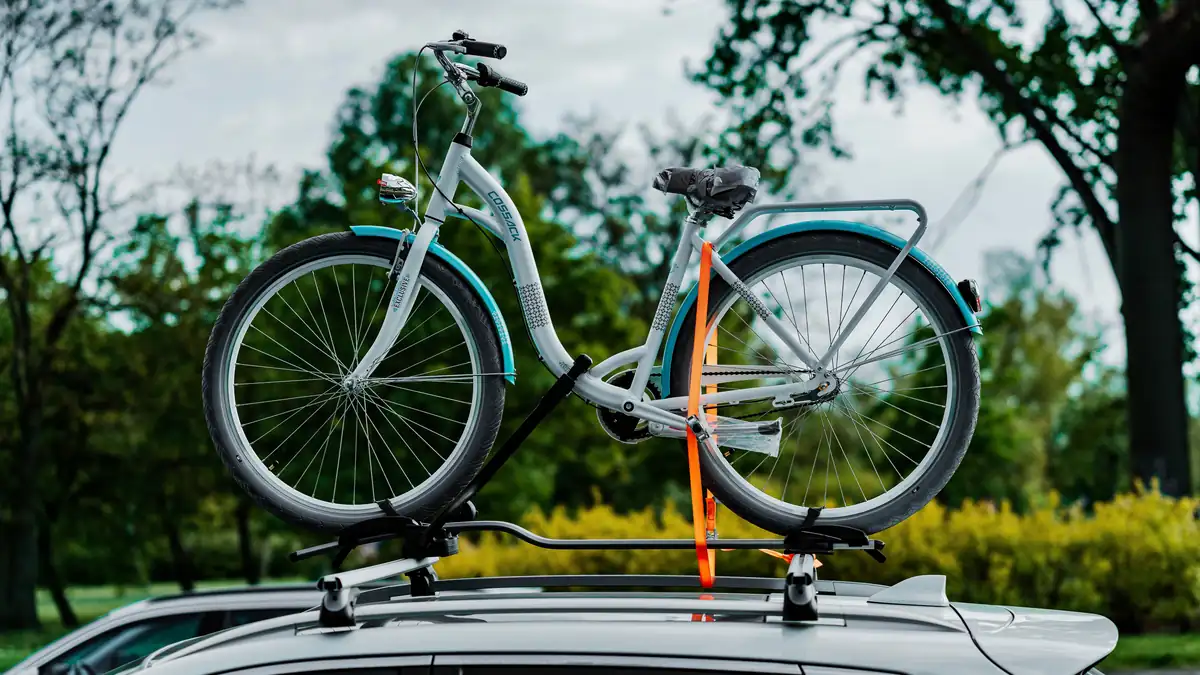
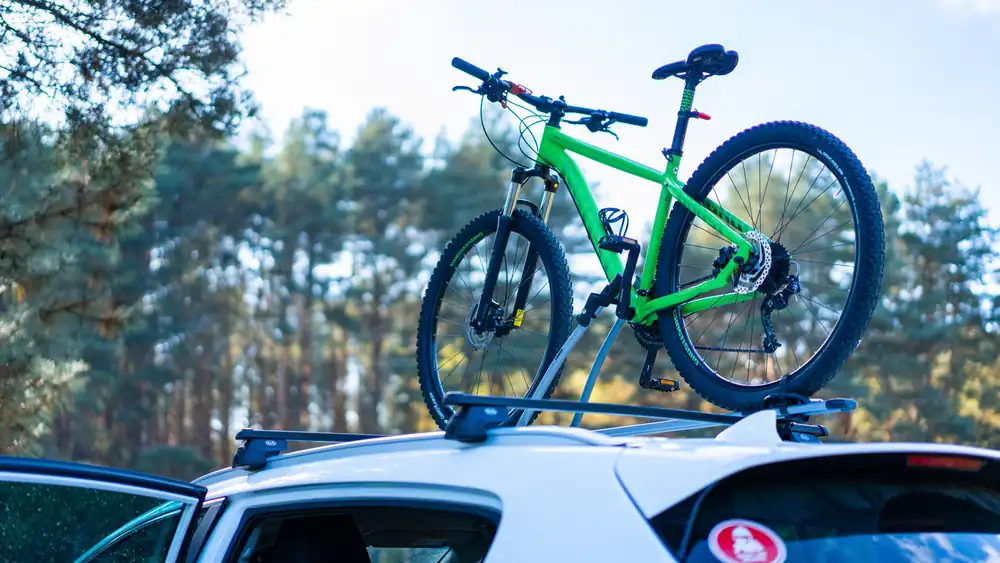
Roof carriers fix to roof bars and hold one bike each, usually upright. They leave the boot, plate and lights untouched, and you can fit several carriers side by side, depending on the width of your bars.
Two limits apply, and you need to check both:
- The carrier’s bike-weight limit. Thule’s ProRide roof carrier, for instance, is rated for bikes up to 20 kg and weighs 4.2 kg itself. Many e-bikes weigh more than 20 kg, so check the actual figure for yours.
- The car’s maximum roof load, listed in the handbook. It has to cover the roof bars, the carriers and the bikes together.
The everyday risk with roof racks is height. With bikes on the roof, your car will no longer clear things it normally does: multi-storey car park barriers, height-restricted car parks, garage doors and drive-through lanes. Some drivers leave a note on the dashboard as a reminder. Lifting a bike up to roof height is also awkward on a tall car or with a heavy bike, so try it before you commit.
Carrying e-bikes
E-bikes are where most rack purchases go wrong, because three separate limits apply: the rack’s per-bike limit, the rack’s total load, and the car’s nose weight or roof load. A rack that takes two ordinary bikes is not automatically fine for two e-bikes. For most e-bike owners, a towbar platform rack rated for e-bikes is the practical choice.
If your e-bike’s battery is removable, take it off before loading: it reduces the weight on the rack and keeps the battery out of the rain and road spray. Store it in the car, following the bike maker’s instructions. For more on choosing an e-bike, see our electric bike buyer’s guide.
Before you drive off: a checklist
- Every strap, clamp and frame arm tight; give each bike a firm shake.
- Pedals turned so they don’t touch the car or the next bike, and loose items (pumps, bottles, bags) removed.
- Number plate readable from behind, or an extra plate on the rack.
- Brake lights and indicators visible, or a working light board: ask someone to check while you press the brake and indicate.
- Total weight within the rack’s limit and the car’s nose weight or roof load.
- With a roof rack, a reminder about the extra height before you reach any barrier.
- Recheck everything after the first few miles, when straps tend to settle.
Security on the rack
Many racks can be locked to the car, and many lock the bikes to the rack, but those locks are designed to stop casual theft during a short stop, not to replace a proper bike lock. If you are leaving the car parked with bikes on it, lock the bikes with a separate lock as well, or take them off. Our guide on how to lock your bike covers which locks to use.
Do you need a car rack at all?
If the plan is to drive part of the way and cycle the rest every day, a rack is not the only option. A folding bike can go in the boot with no rack, no extra plate and no lighting rules to worry about, and it takes seconds to unload. If public transport covers the first part of your journey, check the rules for taking your bike on the train. And if the issue is space at home rather than transport, see our guide to bike storage at home.
One thing that won’t help with the cost: the Cycle to Work scheme. Cyclescheme’s list of what you can get names “Bike racks for cars” among its exclusions, and our guide to what the Cycle to Work scheme covers explains why.
Frequently asked questions
Do I need a number plate on my bike rack in the UK?
You do if the rack or the bikes cover your car’s number plate. Obscuring a registration mark is an offence under section 43 of the Vehicle Excise and Registration Act 1994, and GOV.UK says incorrectly displayed plates can mean a fine of up to £1,000. The extra plate must show your car’s registration and come from a registered number plate supplier.
Is it illegal if my bike rack covers my rear lights?
If it hides your brake lights or indicators, yes, at any time of day: Regulation 21 of the Road Vehicles Lighting Regulations 1989 requires them to be moved or repeated on the load or equipment. For other rear lamps and reflectors, the same requirement applies between sunset and sunrise. A lighting board on the rack solves both.
Can I carry an e-bike on a roof rack?
Only if the e-bike is within the carrier’s weight limit and the total stays within your car’s maximum roof load. Thule’s ProRide roof carrier, for example, is rated for bikes up to 20 kg, which rules out many e-bikes. A towbar rack rated for e-bikes is usually the easier option.
Can I get a car bike rack through the Cycle to Work scheme?
Not with Cyclescheme, which lists bike racks for cars among the items you can’t get. The scheme is designed for bikes and cyclists’ safety equipment, so check with your own provider if you use a different one.
This guide is general information based on GOV.UK, the Highway Code, legislation.gov.uk and the manufacturers’ published specifications. Rack ranges and specifications change, so check the current details, your car’s handbook and the current price before you buy.