The short answer: a bike trailer is a small wheeled carrier that hitches to the back of your bike, so you can move a child, a dog or a load of shopping without buying a different bike. Child trailers are enclosed, usually take one or two children, and most makers say a child should be about 12 months old and able to sit up with a helmet on before riding in one behind a bike. Cargo trailers are open frames or bags for luggage. Dog trailers are enclosed boxes with a low entry and a tether inside. In the UK you need a red rear reflector on the trailer, and a rear light on it after sunset, and you cannot take a trailer on National Rail trains.
This guide is for people who already ride for transport and want to carry more than a pannier allows. It explains the three types, how they attach, what the law says, how riding with one feels in traffic, and how a trailer compares with a cargo bike or a child seat. It does not rank models. Specifications change between versions, so check the maker’s page and the current price before you buy.
Child, cargo and dog trailers at a glance
| Child trailer | Cargo trailer | Dog trailer | |
|---|---|---|---|
| What it carries | One or two children, plus a little luggage | Shopping, bags, tools, camping kit | One dog |
| Body | Enclosed cabin with harnesses, rain cover and mesh | Open frame, tray or bag | Enclosed cabin with a low door and an internal leash point |
| Usual hitch | Rear axle coupling | Rear axle or seat post, depending on the model | Rear axle coupling |
| Other modes | Many convert to a stroller or jogger with extra kits | Depends on the model | Depends on the model |
| Key limit to check | Child age, child weight and total load | Total load and how it is split | Dog weight |
Child trailers
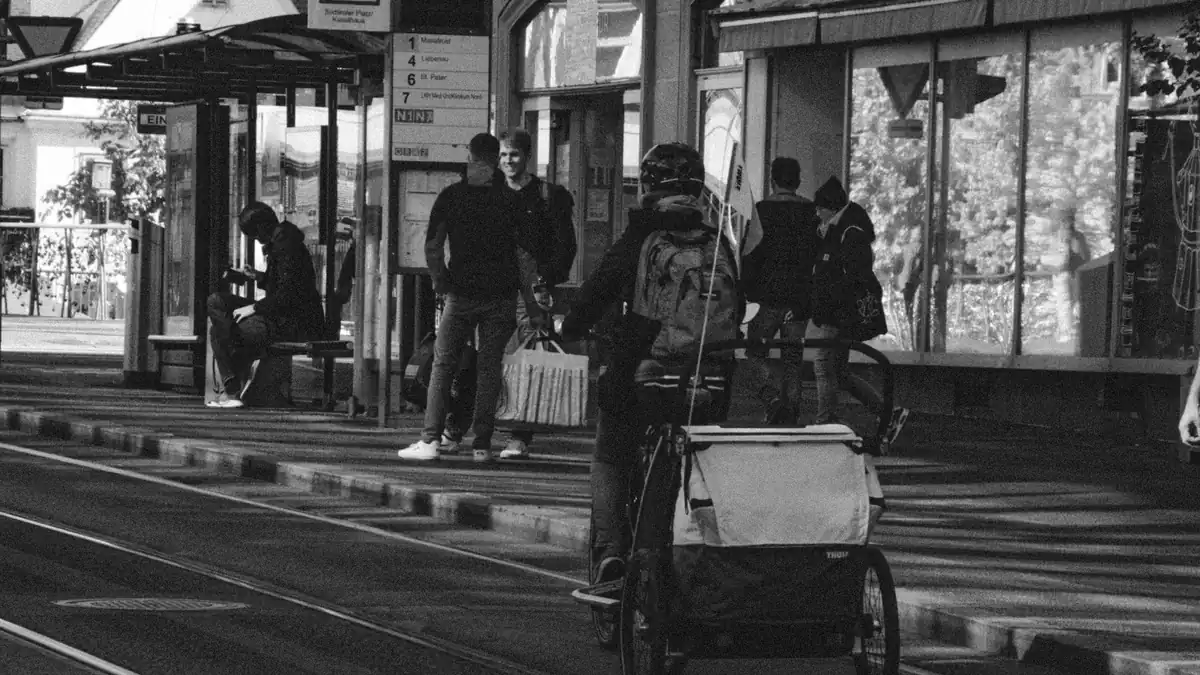
A child trailer is a two-wheeled cabin that sits low behind the bike. The children sit side by side in a harness, under a frame with a rain cover and an insect mesh. Cycling UK’s guide to child trailers points out two practical advantages over a child seat: a trailer can carry more weight, and many fit two children side by side.
How old does a child need to be?
There is no UK law that sets a minimum age for a child in a bike trailer. The guidance comes from the manufacturers, and it lines up closely:
- Burley advises that children should be at least 12 months old to be pulled in a bike trailer, and able to sit upright unattended and hold their head up while wearing a helmet.
- Thule says most children can start once they can sit upright on their own and have good head and neck control, which for many is around 12 months, and that development matters more than age alone.
- Cycling UK says most child-carrying trailers can be used for babies from 12 to 18 months upwards.
Younger babies can often ride in the same trailer when it is pushed as a stroller, with an infant insert or sling from the trailer’s maker. Thule says that in some models strolling mode can be used from around one month with an approved infant sling. That is for walking, not cycling.
Helmets
Both Burley and Thule tell parents to put a helmet on a child riding in the trailer. Thule’s guide answers the question directly: helmets should be worn at all times inside a bike trailer. A child’s helmet can push the head forward against the seat back, so try the fit with the helmet on before the first ride. Our guide to bike helmets for commuting explains the safety standards to look for.
Weight limits
Every trailer has a maximum weight per child and a maximum total load, and they differ between models. As one example, Thule’s page for the Chariot Cross 2 double lists two children, a maximum child weight of 2 × 22 kg and a maximum load capacity of 42 kg. The total includes whatever you stuff in the boot, so a bag of shopping counts too. Read the limits for the exact model and year you are looking at.
Cargo trailers
A cargo trailer is the cheapest way to turn an ordinary commuter bike into something that can do the weekly shop. They range from an open tray on two wheels to a folding frame that holds a large bag. Without a cabin to carry, they are lighter than child trailers, and some fold flat for storage in a hallway.
Look at three things. First, the load limit and how the maker wants it split: Burley’s Travoy, for instance, is rated for up to 27 kg of cargo, with 9 kg on the upper shelf and 18 kg on the lower one. Second, the hitch: the Travoy uses a quick hitch for seat posts of 25–35 mm diameter, which is a different approach from the axle couplings most child trailers use. Third, what happens off the bike. A trailer that also works as a hand cart is useful if your shop is in a pedestrian centre.
A cargo trailer is built for goods, not people. Do not put a child in one.
Dog trailers
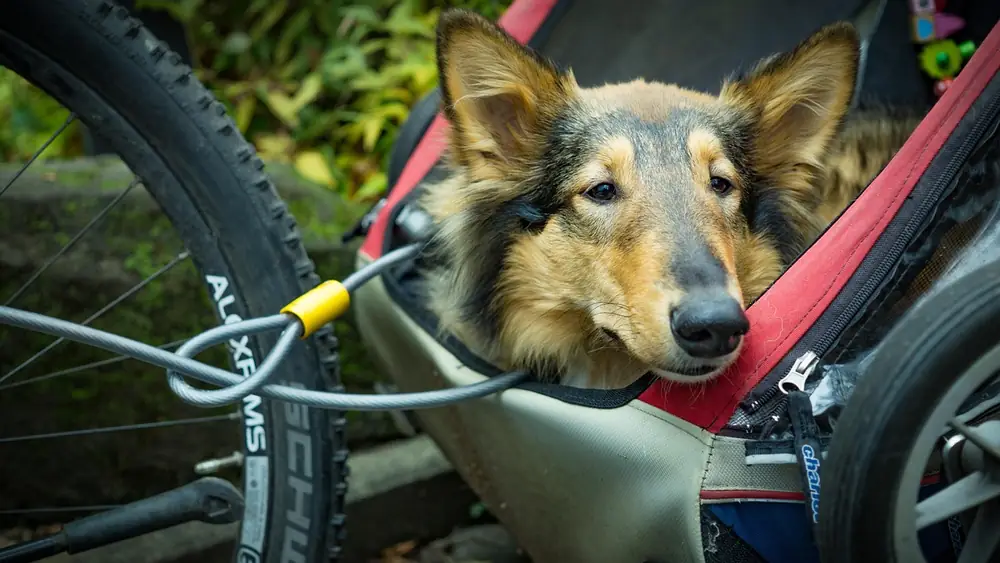
Dog trailers look like child trailers, but the cabin has a low floor, a door at the front or back so the dog can walk in, and a tether point inside so the dog cannot jump out mid-ride. Weight limits are set by the maker: Burley’s Tail Wagon page gives a maximum pet weight of 34 kg. Most dogs need a few short, calm sessions with the trailer parked before they settle in one on the move, and a nervous dog in a box that rocks is a distraction you do not want in traffic.
How a trailer attaches to your bike
Most child and dog trailers use a coupling at the rear axle. Cycling UK describes it as a coupling fitted to the bike’s rear axle quick-release, usually with an extra retaining strap from the trailer arm to the frame. The coupling stays on the bike; the trailer arm clips on and off.
That is simple on a bike with a quick-release rear wheel. Other bikes may need an adapter:
- Thru-axle frames, which are now common on newer bikes with disc brakes, need a hitch or axle made for that axle size. Thule notes that its trailers may require an adapter.
- Hub-gear and hub-motor bikes use axle nuts rather than a skewer, so a standard quick-release coupling will not fit. Thule, for example, lists a separate internal hub hitch adapter for e-bikes.
- Several bikes in one household: Cycling UK suggests choosing a trailer for which you can buy additional hitches, so each adult bike can tow it.
Before you buy, check your rear axle type (quick-release, thru-axle or nutted) and then the trailer maker’s compatibility list for that hitch. It is the most common reason a new trailer will not fit.
Can you tow a trailer with an e-bike?
Often, yes, and an e-bike makes a loaded trailer much easier on hills. Thule says its trailers are designed to work with most modern bikes, including many e-bikes. Two checks matter. First, the bike: some e-bike makers say in the manual whether the frame is approved for towing and what the limits are, so read it. Second, the axle: a hub-motor e-bike needs a hitch made for a nutted axle, like the adapter mentioned above.
In Great Britain, a legal electrically assisted pedal cycle stops giving motor assistance above 15.5 mph, according to GOV.UK’s electric bike rules. Trailer makers also state their own speed limits in the manual, so read those too: with a child on board, the trailer’s limit is the one that counts. Our e-bike buyer’s guide explains what counts as a legal e-bike.
What UK law says about bike trailers
The rules are short, but there are a few you must follow.
Passengers
Rule 68 of the Highway Code says you must not “carry a passenger unless your cycle has been built or adapted to carry one”. A child trailer is made to carry children; a cargo trailer is not, and neither is a basket or rack.
Reflectors and lights
Schedule 18 of the Road Vehicles Lighting Regulations 1989 lists “a trailer drawn by a pedal cycle” among the vehicles that need one red rear reflector. For trailers made on or after 1 October 1989, the reflector must carry an approval mark incorporating “III” or “IIIA”, and trailers are among the few vehicles allowed triangular rear reflectors.
Cycling UK’s summary of the lighting regulations adds that cycle trailers also need a rear lamp, and that lights are needed between sunset and sunrise. It also notes that many trailer makers fit round cycle-type reflectors and leave no provision for a rear lamp. On a winter commute home that is a real gap: your bike’s rear light can be hidden behind the trailer. Fit a clip-on red light to the back of the trailer itself. Our guide to bike lights for commuting explains the different types.
Trains
National Rail’s page on train travel with bicycles states that motorcycles, tricycles and bicycle trailers are not permitted. If part of your journey is by rail, a trailer will not come with you. Our guide to taking your bike on the train covers the rules for the bike itself.
Riding with a trailer in traffic
A trailer changes how the bike handles. It adds length, width and weight, and on corners its wheels cut inside the line of your own rear wheel. A few habits help:
- Practise empty first. Ride a quiet street or car park with an empty trailer, then with a bag of weight in it, before you carry a child or a dog.
- Take bends gently. Cycling UK warns that every trailer has a tipping point if it is overloaded, so do not take bends too fast and tight.
- Give yourself room. You are a wider load, so ride further out from the kerb, and keep at least a metre from parked car doors, as Cycling UK’s instructor advises. Our guide to cycling safely in traffic explains road position in more detail.
- Use the flag. Most trailers come with a large warning flag. It puts something at a driver’s eye level when the trailer itself is below the line of a bonnet.
- Check your brakes. Stopping distances grow with the extra weight. Make sure your brakes are in good order before the first loaded ride.
- Load low and even. Heavy items go low and central, within the maker’s limits, so the trailer tracks straight.
Plan routes with the trailer’s width in mind as well. Narrow chicanes, staggered barriers and steps on cycle paths that a solo bike passes easily can stop a trailer.
Trailer, cargo bike or child seat?
A trailer suits you if you already have a bike you like, only need the extra capacity some days, and have somewhere to keep the trailer. It comes off when you do not need it, and the same trailer can move between two adults’ bikes with a second hitch.
A cargo bike suits you if you carry children or goods most days, or need to fit through barriers and park in less space than a bike plus trailer. It costs more and needs more storage. We compare the types in our guide to cargo bikes for commuting.
A rear child seat is lighter and cheaper, and keeps the child close to you, but carries one child and little else. Cycling UK’s point stands: trailers carry more weight than seats and often take two children.
If you are thinking of buying through the Cycle to Work scheme, whether a trailer counts depends on your provider and your employer, so check before you order. Our guide to what the Cycle to Work scheme covers explains how providers handle accessories.
Frequently asked questions
Is it legal to tow a child in a bike trailer in the UK?
Yes, using a trailer built to carry children. The Highway Code’s rule 68 only bans carrying passengers on a cycle not built or adapted to carry one. The trailer needs a red rear reflector, and Cycling UK’s reading of the lighting regulations is that it also needs a rear lamp after sunset.
What age can a baby go in a bike trailer?
Burley says at least 12 months, and Thule says once the child can sit upright on their own with good head and neck control, which is often around 12 months. Younger babies can use some trailers in stroller mode only, with the maker’s infant insert.
Does a child need a helmet in a bike trailer?
There is no UK law requiring one, but both Burley and Thule tell parents to use one. Thule says helmets should be worn at all times inside a bike trailer.
Can I take a bike trailer on a train?
Not on National Rail services, which state that bicycle trailers are not permitted.
This guide is general information based on the Highway Code, the Road Vehicles Lighting Regulations, Cycling UK, National Rail and the manufacturers’ published pages linked above. Product ranges, limits and specifications change, so check the details for the exact model and the current price before you buy.