The short answer: yes, you can take a bike on most UK trains, and it is usually free. What changes from one operator to the next is when you can travel and whether you need to book. Long-distance operators such as LNER and Avanti West Coast require a free reservation. Many commuter operators need no booking but keep full-size bikes off their busiest London trains. In London, the Tube, Overground and Elizabeth line all limit non-folding bikes at peak times, and non-folding e-bikes are not allowed on them at all.
There is no single national timetable for bikes. The National Rail guidance tells you to check the policy of each company you travel with, so a journey with a change can involve two sets of rules. This guide covers full-size bikes, based on the operators’ published policies as we read them in November 2026. Those policies change, so check yours before you set off. If you ride a folder, most of this will not apply: our folding bike commuting guide covers that side.
The national rules that apply almost everywhere
Section 22 of the National Rail Conditions of Travel (the edition dated 30 July 2026) is short. Non-folding cycles are permitted on most services, but restrictions may apply at particular times or on particular days, a charge may be made, and a reservation may be required. Most of the operators in this guide say bikes travel free or that reservations cost nothing, but the conditions leave room for a charge, so do not assume it for every service.
National Rail adds some general points that catch people out:
- Bikes travel at the owner’s risk.
- Unaccompanied bikes are not permitted, so you cannot send one ahead.
- Motorcycles, tricycles and bicycle trailers are not permitted.
- Bikes must stay in designated areas and must not block doors or aisles.
- Non-folding bikes are not allowed on buses, including rail replacement buses.
That last point matters more than it sounds. If engineering work puts part of your journey on a bus, a full-size bike may leave you stranded halfway. Check for planned works before a weekend trip in particular.
Which trains need a reservation?
This table summarises the main operators’ published positions. Staff can still refuse a bike if there is no safe space, even when no restriction applies.
| Operator | Reservation for a full-size bike | Peak limits |
|---|---|---|
| LNER | Compulsory on all services, and free | Book early, as spaces are limited |
| Avanti West Coast | Mandatory, and free | No peak restrictions, but only 4 spaces per train |
| GWR | Free and strongly advised; mandatory on the Night Riviera sleeper | No unreserved bikes arriving at Paddington 07:30–09:30 or leaving 16:00–19:00 |
| CrossCountry | Free and strongly recommended | Unreserved bikes only if space allows |
| South Western Railway | Required on Waterloo to Salisbury and Exeter trains, at least 24 hours ahead | Limits around Waterloo: see below |
| Southeastern | Not needed; first come, first served | Banned on peak services between London and certain stations: see below |
| Thameslink | Not needed | No non-folding bikes on peak trains: see below |
| Northern | Not needed, and not possible; first come, first served | Northern says bikes are permitted at any time |
| ScotRail | Not needed on most routes; needed on some longer routes, and mandatory on the West Highland Line | May not be able to take bikes on the busiest commuter trains |
Where you can reserve, it is worth doing, even if you are not obliged to. A reservation is usually added when you buy your ticket online, or later through your account, by phone or at a staffed ticket office. GWR, for example, takes bookings up to one hour before the train leaves its starting station, and only once you hold a ticket. If a reservation is not honoured and the operator cannot offer equivalent space, Condition 22.2 lets you decide not to travel and claim a refund for the journey without an admin charge. You have 28 days to claim.
Advance tickets are the awkward case. They tie you to one train, and if that train has no room for your bike and reservations are not possible, National Rail’s advice is simply to ask the train company about alternative services. On a route like that, a flexible ticket can be the safer choice.
Peak-time limits on London commuter routes
These are the rules most likely to affect a daily commute. They apply on weekdays, and the times differ just enough to trip you up:
- Thameslink: no non-folding bikes on trains heading towards London and timed to reach or pass through any central London station between 07:00 and 10:00, or on trains heading away and timed to leave or pass through one between 16:00 and 19:00. Public holidays are exempt. You can take a bike at any time between Bedford and Luton Airport Parkway.
- Southeastern: regular bikes are not allowed on peak services between London and Ashford (on Highspeed services), Gillingham, Hayes, Otford and Tonbridge. Peak means trains arriving in London between 07:00 and 09:59, or leaving between 16:00 and 18:59. Elsewhere on peak services, bikes are accepted if there is enough space.
- South Western Railway: at the stations on its restrictions map, you cannot take bikes on or off trains due to arrive at Waterloo between 07:15 and 10:00, or trains leaving Waterloo between 16:45 and 19:00. On the Hounslow loop and at stations between Clapham Junction and Feltham or Strawberry Hill, the limit covers trains due to leave Clapham Junction between 07:45 and 09:00.
- GWR: a reservation gets you around the Paddington limits. Without one, your bike cannot board trains arriving there between 07:30 and 09:30, or leaving between 16:00 and 19:00.
Read the direction carefully. Most of these limits follow the flow of commuters, so a train going out of London at 08:00 may be fine while one going in is not. Thameslink also warns that staff may ask you to remove your bike on a busy train even when no restriction applies, and that you must do so.
Bikes on the Tube, Overground and Elizabeth line
TfL’s rules are detailed, but they are clear. Non-folded bikes are never allowed on buses or trams.
London Overground
Non-folded bikes are allowed Monday to Friday before 07:30, between 09:30 and 16:00, and after 19:00, and at any time at weekends and on bank holidays. There is one useful exception that runs against the flow. You can take a bike on trains leaving Liverpool Street towards Chingford, Enfield Town or Cheshunt between 07:30 and 09:30, and on trains arriving at Liverpool Street from those places between 16:00 and 19:00.
The Tube
The same time windows apply, but only on certain lines and sections. The Circle, District, Hammersmith & City and Metropolitan lines allow bikes anywhere on the line. The Bakerloo, Central, Jubilee, Northern and Piccadilly lines allow them only on specific outer sections, such as the Bakerloo between Queen’s Park and Harrow & Wealdstone. The Victoria line does not appear on TfL’s list at all. TfL publishes a cycles map, which is the quickest way to check a whole journey.
Elizabeth line
Between Paddington and Abbey Wood, the windows match the Tube and Overground. West of Paddington and east of Liverpool Street, bikes are allowed on trains arriving at those stations before 07:30 and after 09:30, and on trains leaving them before 16:00 and after 19:00. Weekends and bank holidays are unrestricted.
The catch comes when you change. TfL says you cannot switch to the Tube with a non-folded bike at Tottenham Court Road (Central or Northern lines), Bond Street (Jubilee), Paddington (Bakerloo), Liverpool Street (Central and Northern) or Stratford (Central).
DLR
The DLR uses the same weekday windows, but only folded bikes can travel to or from Bank, at any time.
E-bikes, tandems and cargo bikes
E-bikes are where the biggest differences lie. TfL does not allow non-folding e-bikes on most of its services, including the Tube, Overground, Elizabeth line and DLR, and that includes standard bikes fitted with a conversion kit. Folded e-bikes are allowed.
On National Rail, the conditions permit electrically assisted cycles similar in size to a traditional cycle, unless an operator’s own policy says otherwise. National Rail describes a road-legal e-bike as pedal-assisted, with a motor of up to 250 watts continuous rated power and no assistance above 15.5 mph. If yours falls within that and is a normal size, most operators treat it as a standard bike. There are limits, though. GWR says electrically modified e-bikes are not permitted, spare batteries cannot be carried, and charging is not allowed on trains or at stations. Southeastern also bans charging on board. Our e-bike buyer’s guide explains the legal definition in more detail.
Northern’s own web pages were not consistent on e-bikes when we checked, so ask the operator directly before relying on one.
Tandems are allowed on very few services. National Rail lists Avanti West Coast, Greater Anglia, LNER and ScotRail (Glasgow to Oban only). Avanti accepts them on Pendolino trains only and requires two reservations. ScotRail’s spaces are limited and have to be arranged by phone by 6pm the day before.
Cargo bikes are the hardest to take. The Conditions of Travel rule out power-assisted cycles with oversized dimensions, and GWR only guarantees to carry bikes with tyres of 7cm or narrower. In practice, plan on a cargo bike not travelling by train unless the operator confirms otherwise. Our guide to cargo bikes for commuting covers what they do well instead.
How to make a bike and train commute work
If the train is part of your daily route, a few habits help:
- Check both ends of the journey. National Rail’s journey planner shows PlusBike information for each operator, and this also covers station parking and cycle hire.
- Arrive early. GWR asks you to be on the platform at least five minutes before departure. Staff or information screens may be able to tell you where the bike spaces will stop.
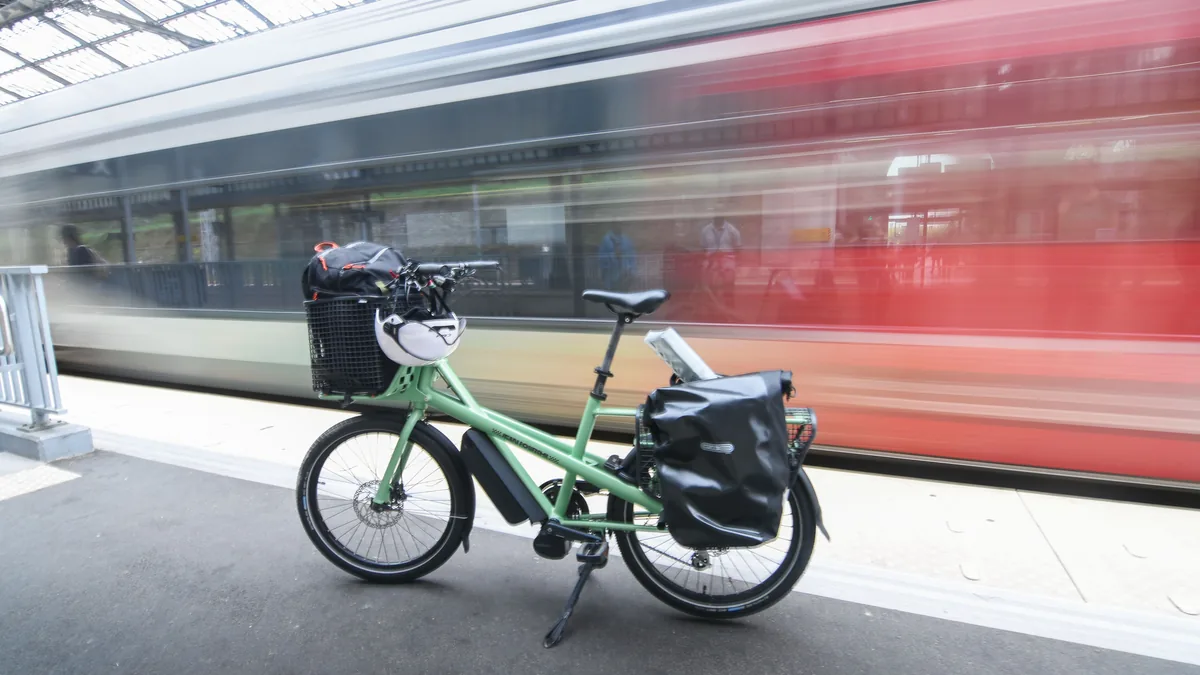
- Do not lock your bike to the train. GWR and Thameslink both say this, as the bike may need to be moved quickly. Take panniers off and keep them with you.
- Never use the wheelchair space as bike parking. Southeastern is clear that wheelchair and mobility scooter users have absolute priority.
- Have a plan B. On a train with two or four spaces, you can be turned away. Know the next train, or a safe place to leave the bike.
Often the simplest option is to leave the bike at the station. If you only need it for the ride to the train, station parking avoids all the rules above, although you will want a good lock and a sensible locking routine. Some commuters keep a cheap second bike at the far end for the same reason. Because bikes are carried at your own risk, it is also worth reading our bicycle insurance guide to see what a policy covers away from home.
If you are travelling at peak times every day, a folding bike is the option that gets around most of these limits. It can also be bought through the Cycle to Work scheme if your employer offers it. Definitions vary, though: Southeastern, GWR and ScotRail specify wheels of 20 inches or smaller, while Thameslink describes small wheels and a frame that folds in more than one place. New to all this? Start with how to start cycling to work, then use our route planner guide to work out the ride to the station.
Frequently asked questions
Can you take a bike on the London Overground?
Yes, if it is a non-folding, non-electric bike and you travel outside the weekday peak: before 07:30, between 09:30 and 16:00, or after 19:00. There are no time limits at weekends or on bank holidays, and TfL allows some counter-peak trips to and from Liverpool Street. Non-folding e-bikes are not allowed.
Do you have to pay to take a bike on a train in the UK?
Usually not. LNER, CrossCountry, Southeastern, Thameslink, Northern and ScotRail all say bikes travel free, and reservations on Avanti West Coast and GWR cost nothing. The Conditions of Travel do allow a charge in some cases, so check if you are using a different operator.
Can you take a bike on a train at peak times?
It depends on the route. Thameslink and parts of the Southeastern and South Western Railway networks restrict full-size bikes at peak times, and TfL limits them across its rail services. Avanti West Coast says it has no peak restrictions and Northern says it permits bikes at any time, although space is limited on both.
Can you take an electric bike on a train?
Usually yes on National Rail, if it is road-legal and similar in size to a normal bike, but not if it is a non-folding e-bike on the Tube, Overground, Elizabeth line or DLR. Check your operator’s policy, because each one can set its own limits.
This guide is general information based on the published policies of National Rail, TfL and the train operators named above, and it does not replace them. Rules can change at short notice, so confirm the position with your operator before you travel.