A decent commuter helmet keeps your head safe on the roads without making your morning ride feel like a military operation. You do not have to wear one by law in the UK — but if you commute in city traffic, the practical case for wearing one is straightforward.
This guide covers what the safety standards actually mean, what features matter for everyday riding (and which are marketing filler), and how to get a helmet that fits correctly. No product prices are included here because retail prices change frequently — always check the current price before buying.
Is wearing a helmet compulsory in the UK?
No. There is no UK law requiring cyclists to wear a helmet. The Highway Code Rule 59 states: “You should wear a cycle helmet that conforms to current regulations, is the correct size and securely fastened.” The word “should” in the Highway Code signals a recommendation, not a legal requirement — there is no fine for cycling without one.
The Department for Transport confirmed in 2023 that it had no plans to introduce mandatory helmet legislation. The Highway Code’s 2022 revisions, which strengthened protections for cyclists and pedestrians, did not change this position.
That said, in the event of an accident, not wearing a helmet may be considered when assessing contributory negligence in a personal injury claim. For daily commuting in traffic, most experienced cyclists wear one.
Safety standards: what to look for on the label
EN1078 — the baseline standard
EN1078 is the European safety standard for bicycle helmets. Any helmet sold in the UK must meet this standard, which covers impact absorption, retention system strength, and field of vision requirements. Look for the CE mark or UKCA mark on the inside of the helmet — both indicate EN1078 compliance. If a helmet has neither, do not buy it.
EN1078 is a pass/fail standard: a helmet either meets it or it does not. Spending more money does not necessarily mean better EN1078 performance. Higher price points typically reflect better ventilation, lighter materials, more adjustability, or additional technologies such as MIPS.
MIPS — what it does and what it does not
MIPS stands for Multi-directional Impact Protection System. A helmet with MIPS contains a low-friction liner between the shell and the head. In an angled impact — which is the most common type in cycling accidents — this liner allows the helmet to slide slightly relative to the head, designed to reduce the rotational forces transferred to the brain.
MIPS is one of several rotational-energy management systems on the market (others include WaveCel, Koroyd, and SPIN). They address a limitation of EN1078, which tests linear impacts but not angled ones. Independent research has shown rotational management systems can reduce certain injury risks, though the exact figures vary by study and scenario. Rather than citing specific percentages, the practical takeaway is: at a similar price point, a helmet with MIPS or equivalent technology offers more complete protection than one without.
For commuting, MIPS is a reasonable feature to seek out — urban collisions typically involve the ground at an angle.
What actually matters for commuters
Ventilation — but not at the cost of coverage
Road-racing helmets maximise airflow through large vents, which works at 20+ mph on clear roads. On slower urban commutes — stopping at lights, riding in traffic — you generate less airflow, so the cooling benefit is smaller. More critically, large vents mean less foam between your head and a kerb.
Urban and commuter-specific helmets tend to have fewer, smaller vents and more closed foam, which provides better all-round coverage. If your commute includes sustained sections at speed (a long greenway or quiet road), a road helmet works fine. If it is mostly stop-start city riding, a more enclosed urban shape gives you more protection where you are most likely to hit something.
Visibility
Highway Code Rule 59 also advises wearing light-coloured or fluorescent clothing during the day and reflective gear at night. The same logic applies to helmets: a white, yellow, or bright-coloured helmet is easier for drivers to spot in traffic and in mirrors than a matte black one.
Many commuter helmets include rear LED mounts or integrated rear lights. This is a genuinely useful feature on a helmet — a tail light mounted at head height is more visible to drivers than one on your seat post, especially in slow-moving traffic. If a helmet you are considering does not have an integrated light, check whether it has a standard rail or clip for aftermarket lights.
All-weather usability
UK commuting means riding in rain. Helmets with large vents let water in and keep you cold — less of a problem in warm countries, but relevant here from October to April. Some commuter helmets include removable visors or have a rounded profile that helps shed rain. A visor also cuts glare from low sun, which is useful on east-facing morning commutes in spring and autumn.
Retention system and fit
How a helmet sits on your head matters more than any other single feature. A poorly fitted helmet offers much less protection than the same helmet worn correctly. Commuter helmets almost universally use a dial-adjust retention cradle at the rear, which lets you micro-adjust the fit without removing the helmet. Make sure the system clamps the occipital bone (the lower rear of your skull) rather than the crown — this locks the helmet in position and prevents it rocking forward in an impact.
The chin strap should form a V-shape under each ear, with the buckle centred under your chin. You should be able to fit one finger underneath when fastened — not two, not zero.
Weight
Weight matters more on long rides than short commutes, but a noticeably heavy helmet will still feel uncomfortable if you commute more than 30 minutes each way. Good commuter helmets sit between 250 g and 350 g for most sizes. Anything significantly heavier than that is worth questioning for daily use.
Helmet types for commuters
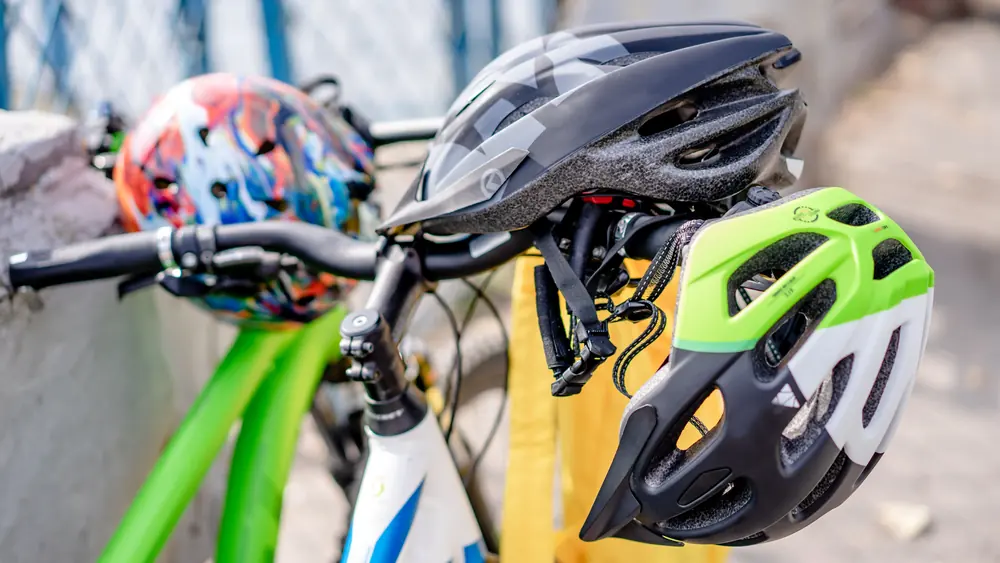
Urban/city helmets — rounded shape, good rear coverage, often with visor and integrated lights. Built for stop-start city riding. Usually heavier than road helmets, but the coverage trade-off makes sense in traffic.
Road helmets with commuter features — more aero shape, better ventilation, often lighter. A good choice if your commute is longer and faster, or you share a helmet between commuting and weekend rides. MIPS variants are widely available at mid-range price points.
Half-shell/skate-style helmets — round dome shape, good rear and side coverage, often heavier and warmer. Popular in city cycling scenes; tend to offer decent protection at low speeds. EN1078-certified variants are available.
For most UK commuters — a mix of urban roads, bike lanes, and roundabouts — an urban helmet or a mid-range road helmet with a rear-light mount is a practical choice. Check current prices before buying, as ranges change seasonally.
When to replace a helmet
Replace a helmet immediately after any impact, even if it looks undamaged. Foam liners absorb energy by deforming internally — damage is often invisible but the protection is reduced. A helmet that has taken a hit is no longer fully protective.
Even without impacts, most manufacturers recommend replacing helmets every three to five years. UV exposure and sweat degrade the foam and straps over time. If the retention dial no longer clicks firmly, straps are fraying, or the foam feels compressed unevenly, replace it.
Frequently asked questions
Do cyclists have to wear a helmet in the UK?
No — there is no law in the UK requiring cyclists to wear a helmet at any age. Highway Code Rule 59 recommends wearing one, but recommendation is not the same as a legal requirement. The Department for Transport confirmed in 2023 it had no plans to legislate.
What does EN1078 mean on a helmet?
EN1078 is the European safety standard for bicycle helmets. It specifies minimum impact absorption, retention strength, and field of vision. Any helmet sold legally in the UK must meet this standard and display a CE or UKCA mark.
Is MIPS worth it for commuting?
MIPS (Multi-directional Impact Protection System) adds a low-friction liner designed to reduce rotational forces in angled impacts — the type most common in cycling accidents. At a similar price point, a helmet with MIPS offers more comprehensive protection. For urban commuting specifically, where impacts often involve the ground or a kerb at an angle, it is a reasonable feature to prioritise.
How do I know if my helmet fits correctly?
The helmet should sit level on your head, roughly two finger-widths above your eyebrows. Use the rear retention dial until the cradle grips the lower rear of your skull firmly — it should not rock forward or back. The chin strap should form a V under each ear and allow only one finger to fit between strap and chin. If it passes those checks, it fits.
For more on staying safe and comfortable on your commute, see our guide to best bike lights for commuting, and if you are new to riding to work, how to start cycling to work covers the practical side of getting set up. If you use your helmet year-round, cycling through a British winter has more on staying comfortable in cold and wet conditions. If you are buying a new helmet as part of a bike purchase, you may also be able to include it in your Cycle to Work scheme — most providers cover helmets and accessories alongside the bike itself.