The short answer: kids’ bikes are sized by wheel diameter, not by frame, and the most reliable way to choose one is your child’s inside leg measurement, checked against the maker’s own chart. Height is the next best guide. Age is only a rough starting point. As a broad pattern from UK brands’ charts, 12-inch and 14-inch wheels suit most three- to five-year-olds, 16-inch suits roughly four to seven, 20-inch roughly six to nine, and 24-inch and 26-inch wheels take over from about eight or nine until a child is ready for a small adult frame. The exact ranges differ from brand to brand, so always use the chart for the bike you are actually looking at.
Below are two published UK size charts, how to measure your child properly at home, what to do when they fall between two sizes, and where balance bikes and stabilisers fit in. If you are sizing a bike for yourself rather than a child, our guide on what size bike you need covers adult frames.
Why the wheel size is only half the story
UK retailers label kids’ bikes by wheel size: a “16-inch bike” has 16-inch wheels. Halfords’ guide says outright that the size of the wheels dictates the correct bike size for kids rather than the frame, and Decathlon UK and Raleigh say the same.
The catch is that two bikes with the same wheels can fit quite differently. Frog Bikes’ sizing guide pointed out that standover height and saddle height can vary wildly on kids’ bikes which have the same size wheels, and that some makers put larger wheels on smaller frames. That is why the better charts list an inside leg range for each model, not just an age.
Kids’ bike size chart by height and inside leg
This is Raleigh UK’s published chart, from its kids’ bike size guide. It gives both height and inside leg for each wheel size, which makes it a useful general reference.
| Wheel size | Rider height | Inside leg |
|---|---|---|
| 12″ | 85–98 cm | 33–41 cm |
| 14″ | 88–104 cm | 36–51 cm |
| 16″ | 95–114 cm | 41–51 cm |
| 20″ | 114–129 cm | 53–63 cm |
| 24″ | 128–143 cm | 57–68 cm |
| 26″ | 135–150 cm | 61–81 cm |
Notice how much the ranges overlap. A child with a 50 cm inside leg sits inside both the 14-inch and the 16-inch ranges on this chart, which is exactly the situation where the specific model’s measurements matter more than the label.
Kids’ bike sizes by age
If you only know your child’s age and height, Halfords’ chart is a reasonable first filter. These figures are from the size guide on Halfords’ Irish site; Halfords’ UK pages may show slightly different brackets, so check the chart on the product page you are buying from.
| Child height | Typical age | Wheel size |
|---|---|---|
| 88–97 cm | First bike | 9″–10″ and balance bikes |
| 98–104 cm | 3–5 | 10″–12″ |
| 105–111 cm | 4–6 | 12″–14″ |
| 112–116 cm | 5–7 | 14″–16″ |
| 117–126 cm | 6–9 | 16″–20″ |
| 127–135 cm | 8–11 | 20″–24″ |
| 136–144 cm | 9–12 | 24″–26″ |
| 145–154 cm | 9–12+ | 26″ |
Decathlon UK’s guidance lines up broadly: a 12-inch bike as the usual start for two- to four-year-olds, 14-inch or 16-inch wheels between four and seven, 20-inch for six to nine, and 24-inch to 26-inch wheels for nine to twelve. Use age to narrow the search, then use the inside leg to make the final choice. Frog’s guide was blunt about it: age no, height “more useful than age but still not perfect”, inside leg “the most important measurement”. It also noted that girls often have longer legs and shorter bodies than boys of the same height, so two children of the same height can need different bikes.
How to measure your child’s inside leg
You need a hardback book, a pencil and a tape measure. This is the method from Islabikes’ children’s sizing guide, and Frog’s guide describes the same steps:
- Ask your child to stand with their back to a wall, in socks, feet flat on the floor.
- Put the book between their legs, spine up, and slide it up the wall until it sits firmly against the crotch.
- Mark the wall where the top of the book is.
- Measure from the mark straight down to the floor. That is the inside leg.
For height, Islabikes suggests laying the book flat on your child’s head, marking where its underside meets the wall and measuring down to the floor. Islabikes’ rule is to start from the inside leg: if it falls into two size brackets, choose the one that also matches your child’s height. It also treats its minimum measurements as absolute, so don’t go below the smallest inside leg the maker lists.
How the bike should fit
The numbers on a chart are a shortcut for a simple test: can your child sit on the saddle and control the bike? The brands’ guidance on saddle height depends on the stage your child is at.
- Balance bike: Frog’s guide said the lowest saddle height should be no higher than the child’s inside leg, ideally 2–4 cm below it, so both feet go flat on the ground.
- First pedal bike: the lowest saddle height should be about the same as the inside leg, or 2–3 cm higher for a child who is already confident from a balance bike. Halfords’ test is that they can put the balls of their feet on the floor while sitting on the saddle.
- Second pedal bike onwards: once a child can start and stop confidently, touching the ground on tiptoes is fine, according to Frog.
Your child should also be able to stand over the bike with both feet on the ground. Frog’s rule was that the inside leg should be at least as tall as the standover height (the height of the top tube where the child stands). The highest saddle setting matters too: it tells you how long the bike will keep fitting as your child grows.
Should you buy a size up to grow into?
The brands don’t fully agree. Halfords and Raleigh both suggest going for the larger size when a child is genuinely between two sizes. But Halfords also warns that buying a large bike for a child to “grow into” may put them off riding altogether, and Decathlon UK says buying a frame that is too large is “highly discouraged”, because an oversized bike is harder to steer and makes it difficult for the child to touch the ground.
The two positions fit together. If your child’s inside leg is within the range of both sizes and they meet the larger bike’s minimum, the larger one will last longer. If they are below the larger bike’s minimum, wait. A bike that is too big is harder to control, and that matters most for a nervous or new rider.
Buying second-hand can make the size-by-size progression cheaper, since kids’ bikes are often outgrown long before they wear out. Our guide to buying a used bike covers the checks to make, and they apply to kids’ bikes as much as adults’.
Balance bikes, stabilisers and first pedal bikes
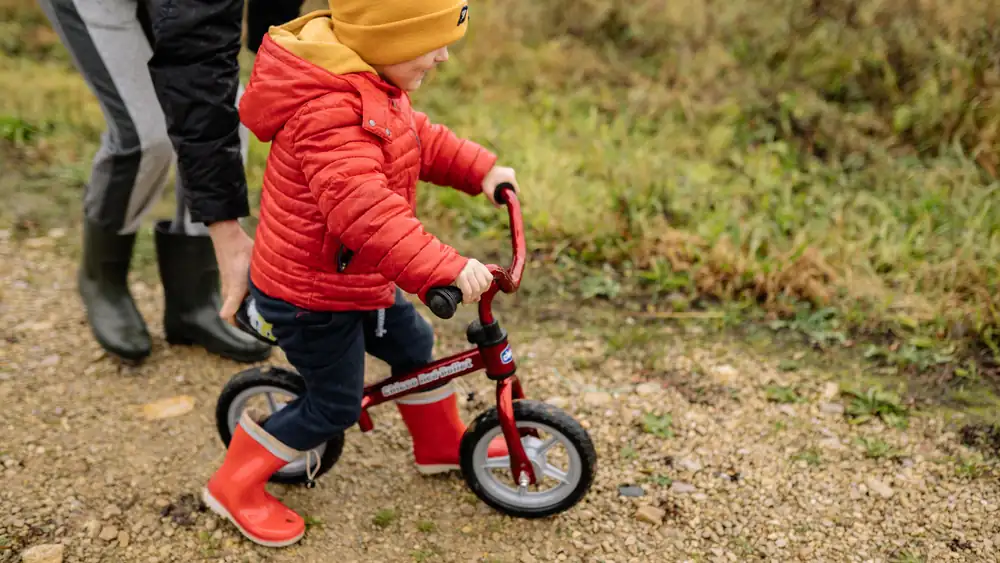
For toddlers, the brands’ advice is consistent: start with a balance bike. Raleigh calls bikes without pedals ideal for a child’s first experience of riding, and Decathlon UK calls a pedal-free balance bike the perfect introduction, “without the distraction of pedals”. Balance bikes come in sizes too: Islabikes, for example, listed a minimum inside leg of 30 cm for its 12-inch balance bike.
Stabilisers are still common on 12-inch to 16-inch bikes. Halfords says they usually suit children aged three to five, and that there is no pressure to take them off before a child is ready. Many beginner bikes come with removable stabilisers, so the same bike can be used with and without them.
From the 24-inch and 26-inch sizes, some children move straight on to an adult bike with a small frame. Halfords’ chart starts its adult 14-inch frames at about 148 cm tall, from roughly eleven years old. At that point, adult sizing rules take over, and our bike size guide explains how frames are measured.
Checklist before you buy
- Measure inside leg and height on the day you shop, because children grow quickly.
- Compare those figures with the chart for the exact model you are considering, not a generic table.
- Make sure your child meets the bike’s minimum inside leg, and look at the maximum saddle height to see how long it will fit.
- If you can, let your child sit on the bike. Halfords’ own advice is that the best way to check the fit is to get them to ride it.
- Add a helmet that fits properly. Our guide to bike helmets covers what to look for.
- Check the current price, and compare new against second-hand.
Frequently asked questions
What size bike does a 5-year-old need?
Usually a 14-inch or 16-inch bike, but it depends on the child. Halfords’ chart puts children of 105–111 cm on 12-inch to 14-inch wheels and 112–116 cm on 14-inch to 16-inch wheels. Measure the inside leg and check it against the chart for the bike you are looking at.
What size bike for an 8-year-old?
Most eight-year-olds ride a 20-inch or 24-inch bike. On Raleigh’s chart, the 20-inch range runs from 114 cm to 129 cm tall and the 24-inch range from 128 cm to 143 cm, so your child’s height and inside leg decide which one fits.
Is inside leg or height more important for sizing a kids’ bike?
Inside leg. Frog, Islabikes and Raleigh all put it first, because it decides whether your child can reach the ground from the saddle and stand over the frame. Height is a useful second check when the inside leg falls between two sizes.
When should a child move from a balance bike to a pedal bike?
None of the size guides we read sets an age for it, so go by your child’s confidence rather than the calendar. When you move them on, Frog’s advice was to set the pedal bike’s saddle at about their inside leg, or a little higher if they are already confident.
This guide is general information based on the published size guides of Raleigh UK, Islabikes, Halfords and Decathlon UK, and archived copies of Frog Bikes’ guide, all linked above. Size charts change and differ between models, so always check the chart for the specific bike and the current price before you buy.