The short answer: a pedal assist bike is an electric bike whose motor only helps while you are pedalling. Sensors tell the controller that you are turning the cranks (and, on many systems, how hard you are pushing), and the motor adds power on top of your effort. In Great Britain that kind of bike can be ridden like an ordinary bicycle from age 14, with no licence, tax or insurance, as long as the motor is rated at no more than 250 watts and stops helping at 15.5 mph.
Most of what makes one pedal assist bike feel different from another comes down to two things: what the sensors measure and how the assistance levels are set up. This guide explains both, then covers the legal points that depend on how the assistance behaves: throttles, walk assist and speed unlocks. If you are choosing a bike rather than trying to understand one, our electric bike buyer’s guide covers motors, batteries, budgets and the basic legal limits.
How pedal assist works
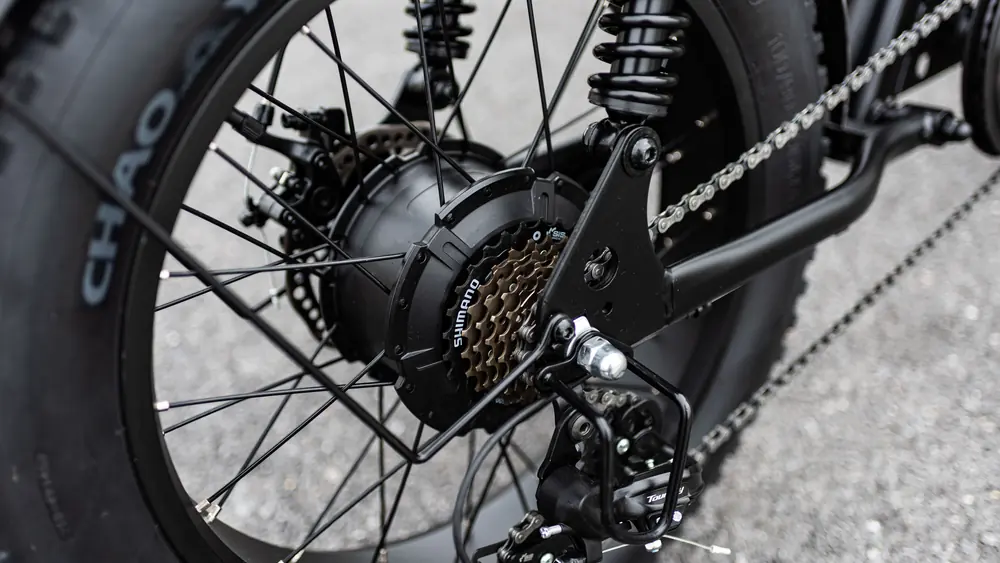
Every pedal assist system has the same parts: sensors that read what you are doing, a controller that decides how much help to give, and a motor that delivers it. The motor sits either in the hub of a wheel or between the cranks (a mid-drive). The battery powers the lot.
The sequence is simple. You start pedalling, the sensors report it, and the controller tells the motor to add power according to the assistance level you have chosen. Stop pedalling and the help stops. Once the bike reaches the cut-off speed, the motor stops helping too. Tern’s support guide to Bosch systems puts it plainly: you can still go faster if you pedal hard or ride downhill, but the motor “will only assist you once your speed falls under the cutoff again”.
What varies is how much the controller knows about your pedalling. That depends on the sensors.
Cadence sensors vs torque sensors
Cadence sensing: “are you pedalling?”
A cadence sensor detects that the cranks are turning, and how fast. It does not measure how hard you are pushing. The controller therefore cannot match its help to your effort: it gives the amount set for the level you have chosen, whether you are pressing hard or barely turning the pedals.
That has two consequences you will feel on the road:
- Little effort, plenty of help. On a flat road you can turn the pedals lightly and the bike still moves along at the level’s set power. Some riders find that is exactly what they want.
- Less fine control. Because the help does not rise and fall with your effort, you manage your speed mainly by changing the assistance level, braking or easing off the pedals altogether.
Torque sensing: “how hard are you pushing?”
A torque sensor measures the force you put through the pedals. With that information the controller can scale its help to your effort: push harder on a hill and the motor gives more, ease off on the flat and it gives less. The result feels closer to riding an ordinary bike, with you deciding how much work the motor does from one pedal stroke to the next.
Many systems use both. According to Tern’s guide, the Bosch system has three sensors measuring torque (how hard you are pedalling), cadence (how fast you are turning the pedals) and speed, and they work together to tell the motor controller how you are riding. Tern adds that all three need to be working correctly for the system to run.
Which should you choose?
| Cadence only | Torque (often with cadence and speed) | |
|---|---|---|
| What it measures | Whether, and how fast, the cranks turn | How hard you push on the pedals |
| How the help behaves | A set amount at each level | Rises and falls with your effort |
| How you control speed | Mostly by changing level | Mostly with your legs, as on a normal bike |
| Suits | Riders who want the most help for the least effort | Riders who want a natural feel and fine control in traffic |
A product page will not always say which kind of sensor a bike uses, so ask the retailer, and test ride before you buy if you can. The difference is easier to feel than to read about.
Assistance levels and what they do to your range
Every pedal assist bike lets you choose how much help you get. The names vary by brand. Bosch’s riding modes page lists modes including Eco, Tour, Sport, Turbo and Auto, and says you can adapt all of its riding modes in the eBike Flow app. Other motor makers use their own names, and cheaper bikes often just number the levels. Check the manual for your system, because the same word can mean a different amount of help from one brand to the next.
Whatever the label, more help means more energy taken from the battery. Bosch notes on the same page that battery consumption depends on the riding situation, the rider’s own pedal power and the maximum support available. That is why no single range figure fits every rider: the hills on your route, the wind, the level you choose and how much you pedal yourself all change it. If your bike uses a Bosch system, the company’s Range Assistant gives an estimate for different riding modes and conditions; treat any figure as a guide rather than a promise.
For a typical commute, a sensible habit is to ride in a low level on the flat and save the higher levels for hills and pulling away. If you want to know what charging costs, our e-bike running cost calculator does the sums.
What is legal in the UK: throttles, walk assist and speed unlocks
GOV.UK calls a road-legal e-bike an electrically assisted pedal cycle (EAPC). Its electric bike rules set the limits: pedals that can propel the bike, a motor with a continuous rated power of no more than 250 watts, and no motor propulsion above 15.5 mph. Our buyer’s guide covers the rest of the basics. Three points relate directly to how the assistance behaves.
Throttles and “twist and go”
A throttle moves the bike without you pedalling, so it is not pedal assist. GOV.UK says an electric bike must be approved if it can be propelled up to 15.5 mph without pedalling, giving “twist and go” as the example. That approval should be done by the manufacturer or importer before you buy, and an approved bike is marked with its approval number. If it has not been approved, GOV.UK points to Motorcycle Single Vehicle Approval.
The exception is walk assist, the low-speed mode that helps you push a heavy bike up a ramp or out of a shed. The government’s EAPC information sheet says walk assist “where the speed doesn’t go above 3.7 mph” is outside the scope of type approval. For the background to the throttle rules, including the recent consultation, see our conversion kit guide.
“Off road” modes and speed unlocks
Some e-bikes have a setting that raises the assisted top speed, often advertised as an “off road” mode. The same information sheet says that when such a mode lets the motor propel the bike above 15.5 mph, the bike does not, in the government’s opinion, comply with the EAPC regulations and is considered a motor vehicle. Aftermarket “tuning” devices that fool the speed sensor lead to the same place: GOV.UK says a bike is not an EAPC if the motor can propel it at more than 15.5 mph.
If the bike is not an EAPC
GOV.UK classes it as a motorcycle or moped. It must be registered, taxed and insured, you need a driving licence and a motorcycle helmet, and you can only ride it on the road, not on cycle tracks or cycle lanes. Riding one uninsured can mean a fine, or the police may seize the bike. Ordinary bicycle insurance is written for bicycles, so read the policy wording before you assume a modified e-bike is covered.
Is pedal assist worth it for commuting?
For many commuters the appeal is arriving less sweaty after hills, headwinds or a longer distance than they would ride on an ordinary bike. You still pedal, and a compliant EAPC can use cycle paths like any bicycle. Against that, an e-bike costs more to buy, the battery will eventually need replacing, and the extra weight makes it harder to lift, carry and lock. Our piece on whether e-bikes are worth it for commuting weighs that up in more detail.
If you plan to buy through your employer, our Cycle to Work scheme guide explains how e-bikes fit in, and our guide to schemes over £1,000 covers higher-value bikes. Check current prices and your employer’s limit before you choose.
Frequently asked questions
What is the difference between pedal assist and an electric bike?
Pedal assist is the way most road-legal electric bikes work: the motor helps only while you pedal. Some electric bikes also have a throttle that moves the bike without pedalling. In Great Britain a bike that can be propelled up to 15.5 mph without pedalling needs vehicle approval, while a walk assist that stays at or below 3.7 mph is outside the scope of type approval.
Do I need a licence or insurance for a pedal assist bike?
Not if it meets the EAPC rules and you are 14 or over. GOV.UK says you do not need a licence to ride an EAPC and it does not need to be registered, taxed or insured. A bike outside the limits is treated as a motorcycle or moped.
Can a pedal assist bike go faster than 15.5 mph?
Yes, on your own power. The motor must not propel the bike above 15.5 mph, but you can still pedal harder or roll downhill faster. The assistance comes back once you drop below the cut-off.
Is a torque sensor better than a cadence sensor?
It depends on what you want. A torque sensor matches the help to your effort and feels closer to a normal bike. A cadence sensor gives a set amount of help for little effort. Test ride both if you can.
This guide is general information, not legal advice. It is based on the official guidance and manufacturer pages linked above, checked on 27 November 2026. Rules, specifications and prices change, so check the current pages before you buy or ride.